20 Outdoor Kitchen Ideas for South Florida Homes: Layouts, Materials and Design
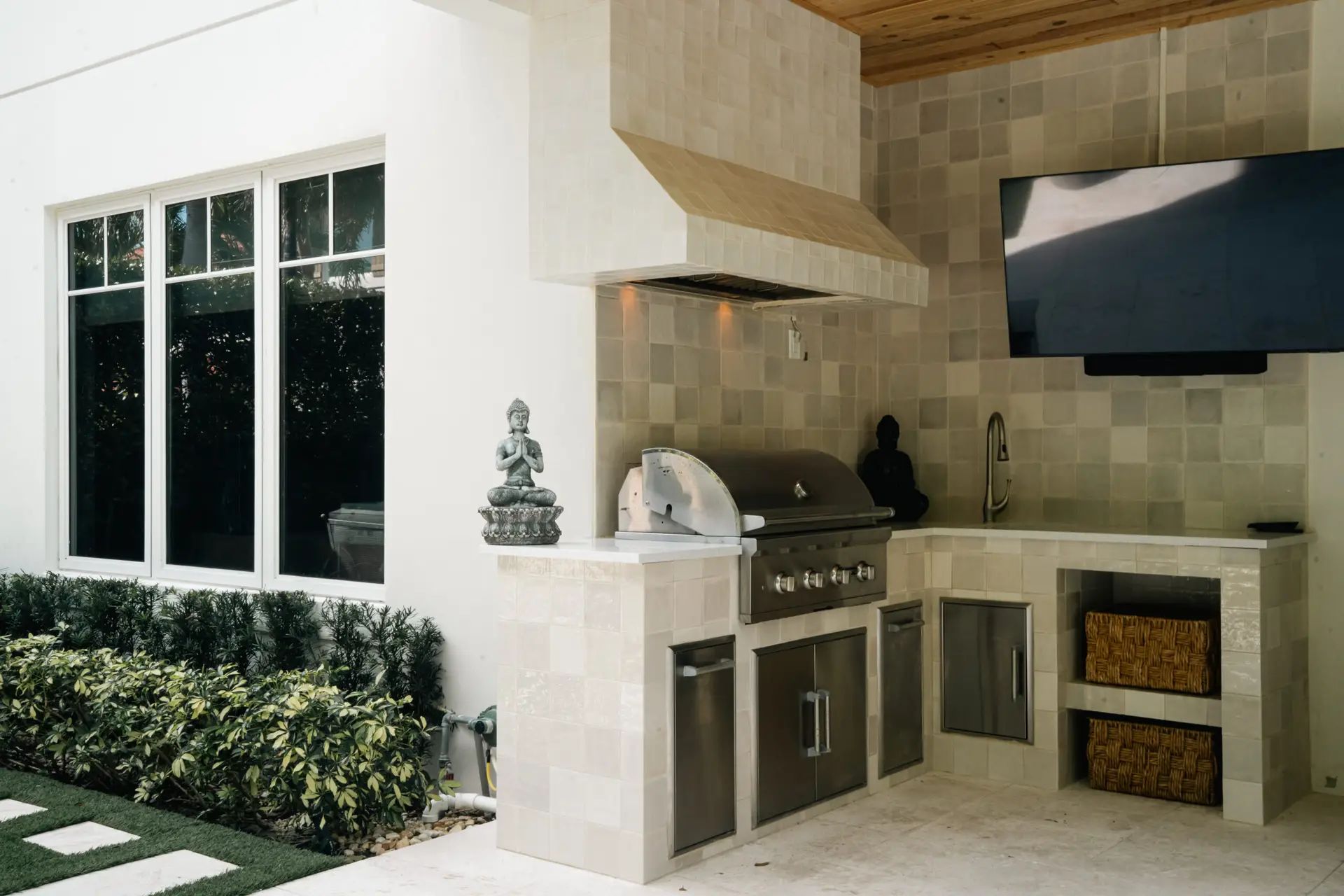
South Florida is made for outdoor cooking. You can grill in January, entertain by the pool in April and host family on the lanai at Thanksgiving. The same climate that makes outdoor kitchens so useful is also hard on them: intense UV, daily humidity, salt air near the coast, summer downpours and hurricane season.
The outdoor kitchens that still look good after ten years were designed for those conditions from day one. These 20 ideas cover layout, shade, countertops, cabinets, appliances and lighting, plus the permit and cost basics for Palm Beach County homes.
Key Takeaways
- Plan the location first: shade, prevailing wind, distance to the indoor kitchen and where gas, water and power can run.
- Pick materials for sun and salt: 304 stainless at minimum near the coast, cabinets that can’t rot or rust, and countertops that are UV stable.
- Gas, electrical, plumbing and roofed structures need permits, even under Florida’s 2026 permit exemption.
- Angi puts the national average outdoor kitchen at about $16,400, with most between about $6,300 and $26,900 and luxury builds above $60,000.
What makes an outdoor kitchen work in South Florida?
Five conditions shape every good design here:
- Sun and heat. UV fades and weakens many materials, and an unshaded grill station is miserable at 3 p.m. in July.
- Humidity and rain. Wood swells, cheap hardware rusts, and water pools anywhere the counter or slab isn’t pitched to drain.
- Salt air. Within a few miles of the ocean or Intracoastal, low-grade metals pit and corrode quickly.
- Wind and storms. Anything with a roof has to meet wind-load requirements, and everything else has to survive or be secured for a hurricane.
- Bugs and comfort. Fans, screens and smart lighting decide whether you actually use the space after dark.
Layout ideas
The right layout depends on how you cook and how many people you host.
| Layout | Best for | Footprint |
|---|---|---|
| Straight run | Grilling with a little prep space | Compact; fits along a house wall |
| L-shape | Cooking plus a bar or serving side | Moderate |
| U-shape | Serious cooks who want everything in reach | Larger |
| Island with seating | Entertaining around the cook | Larger; needs walkways on all sides |
| Pass-through | Easy carry-out from the indoor kitchen | Depends on the window opening |
1. Start with a straight run along the house
A single counter with a grill, prep space and storage is the most efficient design, and it’s the simplest to shade with an existing roofline. Keep the grill itself away from walls, windows and anything combustible, and follow the manufacturer’s clearances.
2. Add an L-shaped bar
Turning the corner adds a raised bar or serving counter so guests can sit with the cook without crowding the grill.
3. Build a U-shape for full outdoor cooking
If you’ll cook entire meals outside, a U-shape puts the grill, side burner, sink and refrigeration within a step or two.
4. Make the island the centerpiece
A freestanding island with seating on one side works beside a pool deck. Leave comfortable walkways on every side, just like an indoor island.
5. Use a pass-through window
A window or sliding pass-through between the indoor kitchen and the outdoor bar makes serving easier and can save you from duplicating appliances outside.
Covered and shaded ideas
6. Extend the roofline or build a covered lanai
A solid roof is the best protection for appliances and cabinets. Tying into the house roof or building a covered lanai requires a permit and engineering for wind loads.
7. Try a louvered pergola
Aluminum pergolas with adjustable louvers let you open the roof for light or close it for shade and rain. They need to be rated and permitted for Florida wind loads.
8. Add wet-rated ceiling fans
A fan over the seating area moves air, cools guests and helps keep bugs away. Choose fans and fixtures rated for wet or damp locations.
9. Ventilate a covered grill
Under a roof, smoke and heat need somewhere to go. Use an outdoor-rated vent hood sized for the grill, keep the sides open for cross-ventilation, and place the grill so prevailing winds don’t push smoke into the house (JLC).
Countertop ideas
10. Granite
Dense, heat-tolerant and UV stable, granite is a proven outdoor choice. Lighter colors stay cooler in direct sun.
11. Quartzite
Natural quartzite handles sun and heat well. Confirm that the slab is true quartzite, not marble or dolomite sold under a similar name. Our guide to quartz vs quartzite countertops explains how to check.
12. Porcelain and sintered stone
Large-format porcelain slabs are UV stable, stain resistant and lighter than stone. They’re popular for modern outdoor kitchens.
13. Only UV-rated quartz
Standard indoor quartz isn’t made for direct sun and can fade and weaken over time. If you love the look, use a line specifically rated for outdoor use (Caesarstone).
Cabinet and base ideas
14. Marine-grade polymer cabinets
Cabinets made from marine-grade polymers or powder-coated aluminum won’t rot, swell or rust. That makes them a strong fit for poolside kitchens.
15. Block and stucco with stainless doors
A concrete block base finished in stucco to match the house is extremely durable, and stainless steel access doors keep it serviceable (JLC).
16. Upgrade the stainless near the coast
Type 304 stainless is the practical minimum on the coast (JLC). Marine-grade 316, which contains molybdenum, resists salt pitting even better. Use the same grade for hinges, pulls and fasteners, not just the doors.
Appliance and utility ideas
17. Use outdoor-rated refrigeration only
Standard refrigerators aren’t built for outdoor heat. Choose an outdoor-rated undercounter unit or a built-in beverage well (JLC).
18. Plan gas and water carefully
Decide early between natural gas and propane, and put a gas shutoff valve within easy reach of the grill. A sink is great to have, but a drain tied into the sewer can be expensive. Sometimes a hose bib and a smaller prep sink is the smarter budget choice.
Lighting and comfort ideas
19. Layer your lighting
Combine task lights over the grill, under-counter LED strips, soft bar lighting and low-voltage path lights. Use fixtures rated for wet locations, and keep outlets in weatherproof in-use covers.
20. Design for bugs and heat
A screened enclosure, ceiling fans and warm-colored lighting all help. If the kitchen sits inside a pool cage, confirm clearances from the screen and frame for any grill or heat source.
Florida code and permit basics
Most real outdoor kitchens need permits in Palm Beach County. Plan for:
- Gas, electrical and plumbing permits for new lines, outlets and fixtures. Florida’s 2026 permit exemption for small projects (HB 803) never covers this kind of work (WFSU).
- A building permit for roofs and pergolas. All of unincorporated Palm Beach County is in the wind-borne debris region, and roofed structures are engineered for local design wind speeds (Palm Beach County PZB).
- GFCI protection for outdoor outlets, and wet-rated fixtures throughout.
- HOA approval in most communities, often before you submit for permits.
Hurricane-season tips
- Anchor islands and heavy components to the slab.
- Choose grills and refrigeration you can cover, strap down or remove before a storm.
- Shut off gas to the outdoor kitchen when a hurricane is approaching.
- Keep louvered roofs, umbrellas and furniture on your storm-prep checklist.
What does an outdoor kitchen cost?
Angi puts the national average at about $16,425, with most projects between $6,310 and $26,903. Basic setups start around $950, and luxury builds can exceed $60,000 (Angi).
| Component | Typical range |
|---|---|
| Grill | $1,500 to $7,500 |
| Countertops | $1,000 to $5,000 |
| Cabinets and storage | $2,000 to $8,000 |
| Appliances (refrigeration, sink, side burners) | $1,500 to $10,000 |
| Plumbing (water and gas lines) | $500 to $2,500 |
| Electrical | $800 to $3,000 |
| Labor | $3,000 to $10,000 |
| Design | $500 to $3,000 |
Costs from Angi. A covered roof, louvered pergola or major slab work is priced separately.
Five mistakes that cost the most to fix
- Using standard indoor quartz in direct sun.
- Putting the grill against the house or under a low, unvented roof.
- Choosing indoor appliances or low-grade stainless.
- Forgetting shade, so the kitchen never gets used in summer.
- Skipping permits for gas, electrical or a new roof, which can cause problems with insurance or a future sale.
How North2South builds outdoor kitchens
North2South Renovations builds outdoor kitchens, pergolas, covered patios and lanais as part of our exterior renovation services. We plan the layout, utilities, permits and HOA approval together, so your outdoor kitchen works with your home and holds up to the weather.
If you’re also updating the indoor kitchen, our kitchen remodeling services and kitchen remodel checklist are good places to start. When you’re ready, request a free in-home estimate.
Frequently Asked Questions
How much does an outdoor kitchen cost in Florida?
Angi’s national average is about $16,425, with most projects between about $6,300 and $26,900. A covered roof, premium appliances, a sink tied into the sewer and coastal-grade materials push costs higher, and luxury builds can exceed $60,000.
What is the best countertop for an outdoor kitchen in Florida?
Granite, quartzite and porcelain or sintered stone all handle South Florida sun well. Avoid standard indoor quartz unless it’s a line specifically rated for outdoor UV exposure.
Do I need a permit for an outdoor kitchen in Palm Beach County?
Almost always. Gas, electrical and plumbing work need permits, and so does any roof or pergola. Florida’s 2026 permit exemption for small projects doesn’t cover those trades.
What stainless steel is best near the ocean?
Type 304 is the practical minimum on the coast. Marine-grade 316 resists salt pitting better. Use the same grade for hinges, handles and fasteners.
Can an outdoor kitchen survive a hurricane?
A well-built one can. Anchor heavy islands, engineer any roof for local wind loads, choose equipment you can secure or remove, and shut off the gas before a storm.
How far should a grill be from the house?
Follow the grill manufacturer’s clearance requirements, and never install a grill against the house or a combustible surface. Under a roof, add proper ventilation.
References
- How Much Does an Outdoor Kitchen Cost?, Angi.
- Outdoor Kitchens for the South Coast, Journal of Light Construction.
- Quartz Countertops for Outdoor Kitchens, Caesarstone.
- Wind Speed Maps, Palm Beach County Planning, Zoning and Building.
- A New Florida Law Will Drop Permits for Low-Cost Home Projects, WFSU Public Media, May 2026.