Framed vs Frameless Cabinets: Cost, Storage, Style and How to Choose
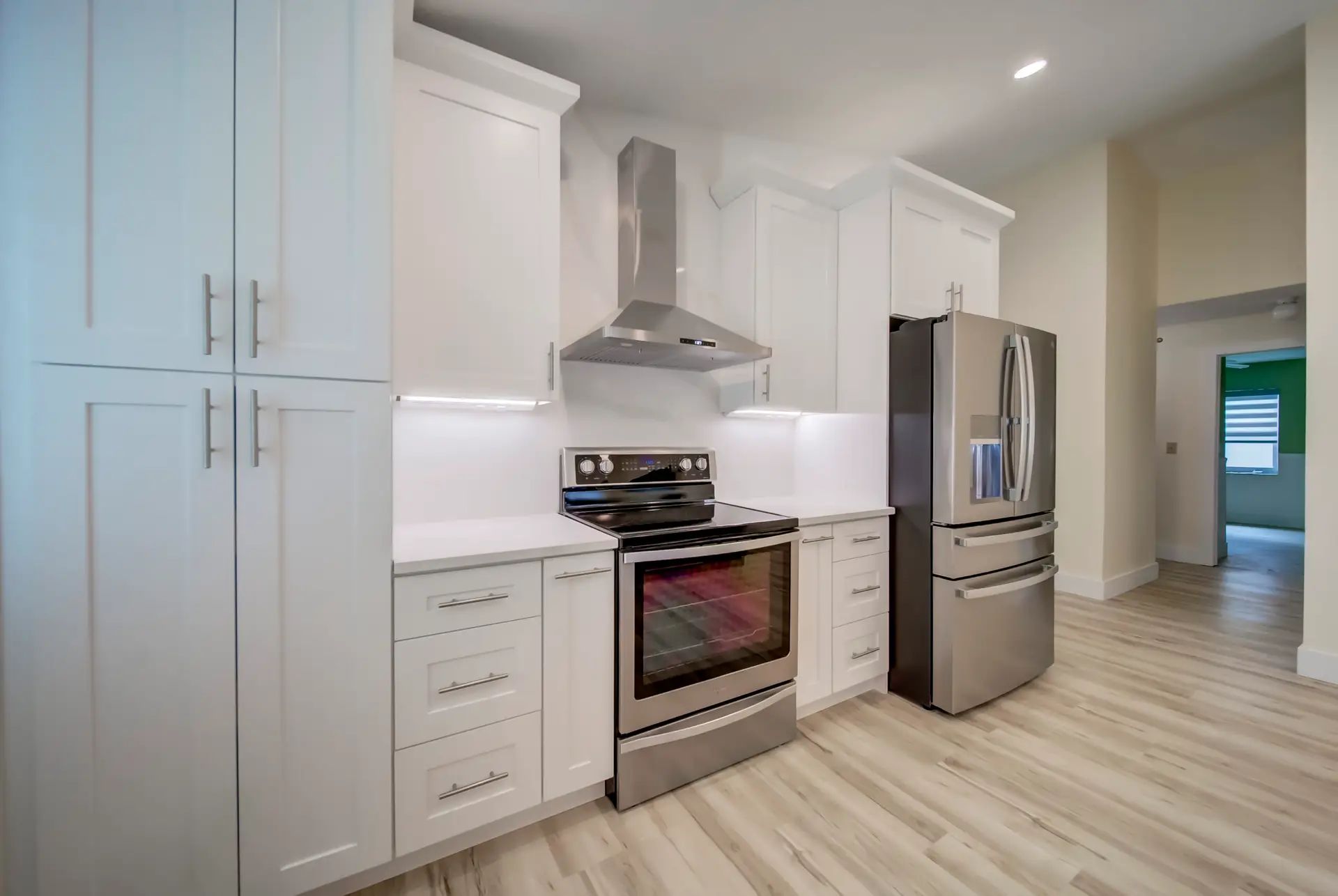
From across the room, framed and frameless cabinets can look almost identical. Open the doors and the difference is obvious: one has a solid frame around every opening, and the other opens straight into the box. That one construction choice affects your storage, which door styles you can have, how the cabinets are installed and, to a degree, what they cost.
Cabinetry is usually the biggest line item in a kitchen remodel, so it’s worth understanding the trade-offs before you pick a door color. Here’s how the two compare, including what matters most in Florida’s humid climate.
Designing new kitchen cabinets?
North2South Renovations designs and installs custom and semi-custom cabinetry, including inset, for homes across Palm Beach County.
Key Takeaways
- Framed cabinets have a solid-wood face frame on the front of the box. Frameless cabinets, also called European or full-access cabinets, get their strength from a thicker box instead.
- Frameless cabinets offer full access to the interior and roughly 20 percent more usable storage. Framed cabinets offer more door styles, including inset.
- Price per linear foot is often similar. Inset doors, which require a face frame, are the premium option.
- In Florida’s humidity, box material, finish quality and certification matter more than whether the cabinet is framed or frameless.
What is a framed cabinet?
A framed cabinet has a face frame, a rectangle of solid wood attached to the front edges of the cabinet box. The frame is typically about 1.5 inches wide and 3/4 inch thick, and it adds rigidity, keeps the box square and gives hinges a solid place to mount (KCMA).
Framed construction is the traditional American style. It allows three door styles:
- Partial overlay. Doors cover part of the frame, leaving more of the frame visible.
- Full overlay. Doors cover nearly all of the frame for a cleaner look.
- Inset. Doors sit inside the frame, flush with its face, for a furniture-like, tailored look.
What is a frameless cabinet?
A frameless cabinet has no face frame. The sides, top, bottom and back are thicker, and they carry the structure. Doors mount directly to the box sides with concealed hinges and cover the full front of the cabinet.
Frameless construction came out of European cabinetmaking, which is why it’s often called European-style. It’s the go-to for modern, flat-panel kitchens with tight, even gaps between doors, though it works with shaker and other door styles too.
Framed vs frameless cabinets: side-by-side
| Framed | Frameless | |
|---|---|---|
| Structure | Face frame adds rigidity at the front | Thicker box sides, top and bottom carry the load |
| Access | The frame narrows each opening | Full access to the box interior |
| Storage | Center stiles and frame edges reduce usable space | Roughly 20 percent more usable storage |
| Door styles | Partial overlay, full overlay or inset | Full overlay |
| Wide drawers | Often limited by a center stile | Wide drawers and pull-outs without a center divider |
| Installation | More forgiving on uneven walls and floors | Requires more precise leveling and alignment |
| Look | Traditional to transitional | Clean, modern, continuous |
| Cost | Similar per linear foot; inset is the premium | Similar per linear foot |
Storage, door style and cost comparisons are based on guidance from the Kitchen Cabinet Manufacturers Association.
Framed cabinets: pros and cons
Advantages of framed cabinets
- More door choices. Inset is only possible with a face frame, and partial overlay is a budget-friendly classic.
- Sturdy and square. The frame helps the box stay square over decades of use and supports heavy countertops.
- Forgiving installation. Fillers and scribe strips hide wavy walls and out-of-level floors, which are common in older Florida homes.
- Easy to adjust. Hinges mount into solid wood, which holds screws well over time.
Drawbacks of framed cabinets
- Less usable space. The frame narrows every opening, and drawers have to clear it.
- Center stiles. Wider sink and drawer bases often have a vertical post in the middle that gets in the way of large pots and trays.
- Busier look. With partial overlay especially, you see more lines and less door.
Frameless cabinets: pros and cons
Advantages of frameless cabinets
- More storage. Without a frame, drawers and roll-outs can be wider and taller, and nothing blocks the opening.
- Wide drawers. Pots-and-pans drawers and roll-out pantries can span the full cabinet width.
- Clean lines. Even, narrow gaps between doors create a seamless, modern look.
- Easy to clean. Fewer edges and ledges inside the cabinet.
Drawbacks of frameless cabinets
- Precision installation. There’s no frame to hide an uneven wall or floor, so the installer has to be exacting.
- Fewer door styles. Doors are full overlay. A true inset look needs a face frame.
- Edge wear. The exposed box edges take more of the daily wear, so edge banding and finish quality matter.
Which costs more?
Less than you might think. The KCMA notes that framed and frameless cabinets often have very similar linear-foot pricing, and that inset framed cabinetry is the most premium option (KCMA).
What actually moves the price:
- Stock, semi-custom or custom. This matters more than frame style. Custom cabinetry also has the longest lead time, often several months (Fixr).
- Box material. Plywood boxes generally cost more than particleboard or MDF.
- Door style and finish. Inset doors, painted finishes and detailed profiles add cost.
- Interior fittings. Roll-outs, drawer organizers, lift-up hardware and lighting add up quickly.
- Installation. Frameless and inset cabinets both take more installer time to get right.
Which works better for small kitchens?
Frameless usually wins in tight spaces. Condo kitchens, galley layouts and small islands benefit from wider drawers, no center stiles and full-access pull-outs. If you love a framed look in a small kitchen, full overlay doors get you closer to frameless storage than partial overlay or inset.
Do framed or frameless cabinets hold up better in Florida humidity?
Both can last for decades in a South Florida kitchen if they’re built and installed well. Frame style is a smaller factor than these:
- Box material. Ask what the boxes are made of. Plywood holds screws well and tolerates moisture better at cut edges. Quality particleboard and MDF can perform well when fully sealed.
- Finish and edge sealing. Every exposed edge, including the underside of the sink base, should be sealed. Painted doors need a durable, factory-applied finish.
- Certification. KCMA certification testing includes moisture resistance, along with structure, hardware and finish durability (KCMA).
- Climate control. Keep the air conditioning running during and after installation. Cabinets delivered to a hot, open house can swell before they’re ever installed.
- Leaks. A slow leak under the sink damages any cabinet. A leak detector or water shutoff valve is cheap insurance.
Can you mix framed and frameless?
Yes. A common approach is frameless perimeter cabinets for maximum storage with a framed, inset island as a furniture-style centerpiece. The key is keeping door gaps, finishes and countertop heights consistent so the pieces feel intentional.
How North2South approaches cabinetry
Our custom cabinets are designed around your layout, your storage needs and the way you cook, with options from semi-custom to fully custom and inset. Because we install what we design, we plan for wall conditions, appliance specs and countertop support from the start.
If cabinets are part of a bigger project, start with our kitchen remodel checklist, compare quartz vs quartzite countertops, or see our kitchen remodeling services. Ready to talk? Request a free in-home estimate.
Frequently Asked Questions
Is framed or frameless better?
Neither is better across the board. Frameless gives you more storage and a modern look. Framed gives you more door styles, including inset, and a more forgiving installation. Choose based on the look you want and how you use your storage.
Do frameless cabinets really have more storage?
Yes. Without a face frame narrowing the openings, frameless cabinets offer roughly 20 percent more usable storage and full access to the interior, according to the Kitchen Cabinet Manufacturers Association.
Are frameless cabinets harder to install?
They require more precision. There’s no face frame to hide an uneven wall or floor, so the installer has to level and align every box carefully to keep the door gaps even.
Are inset cabinets framed or frameless?
Inset doors sit inside a face frame, so inset cabinets are framed. Inset is typically the most premium cabinet style because the doors need tight, consistent gaps.
What cabinet material is best for Florida humidity?
Well-sealed plywood boxes with a durable factory finish are a strong choice. Quality matters more than frame style, so look for certified cabinets and keep the house air-conditioned during and after installation.
Can you mix framed and frameless cabinets in one kitchen?
Yes. Many kitchens pair frameless perimeter cabinets with a framed, inset island. Keep finishes, gaps and countertop heights consistent so the mix looks deliberate.
References
- Framed vs. Frameless Cabinets, Kitchen Cabinet Manufacturers Association (KCMA).
- How Long Does a Kitchen Remodel Take?, Fixr, January 2025.